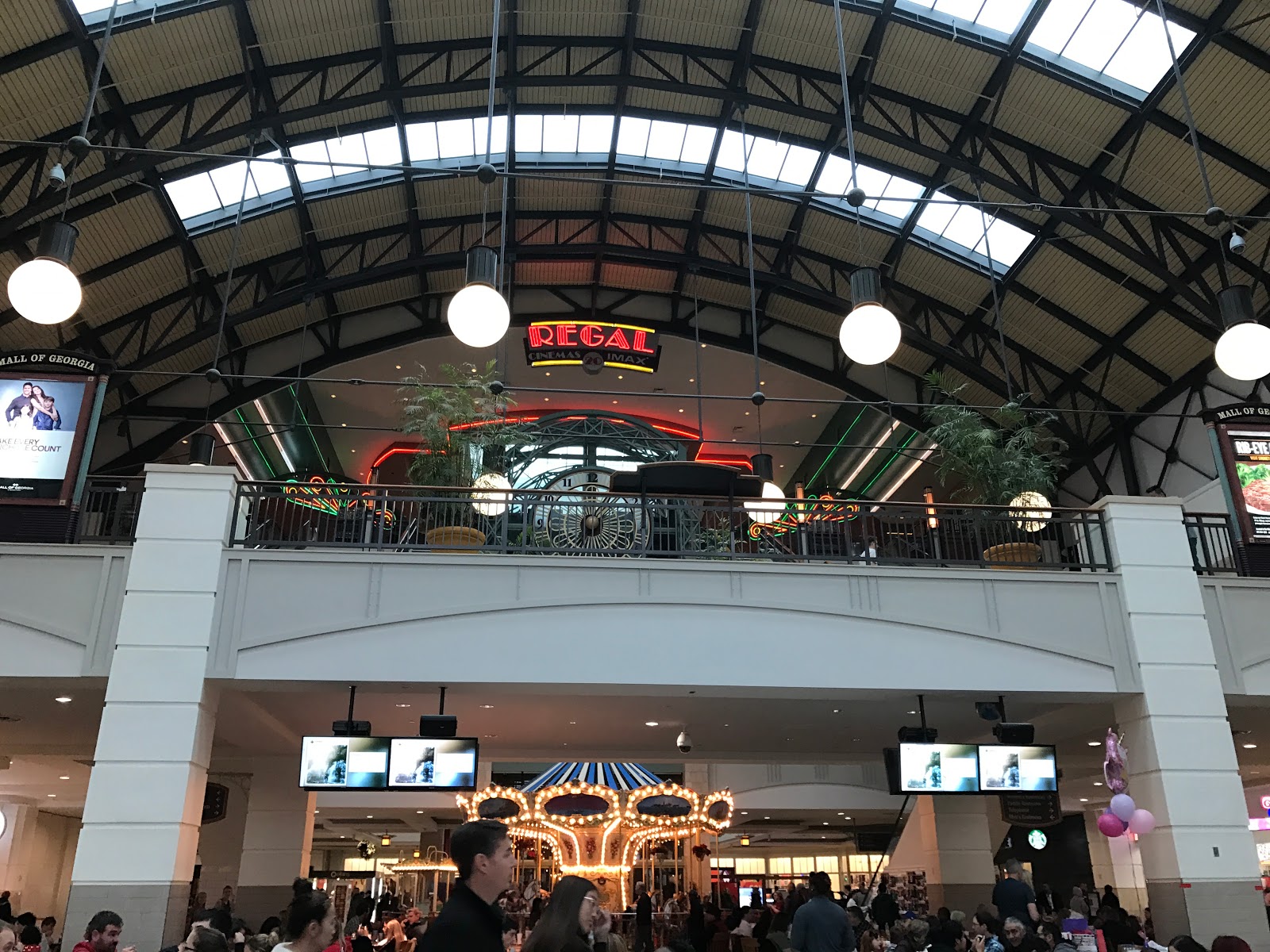
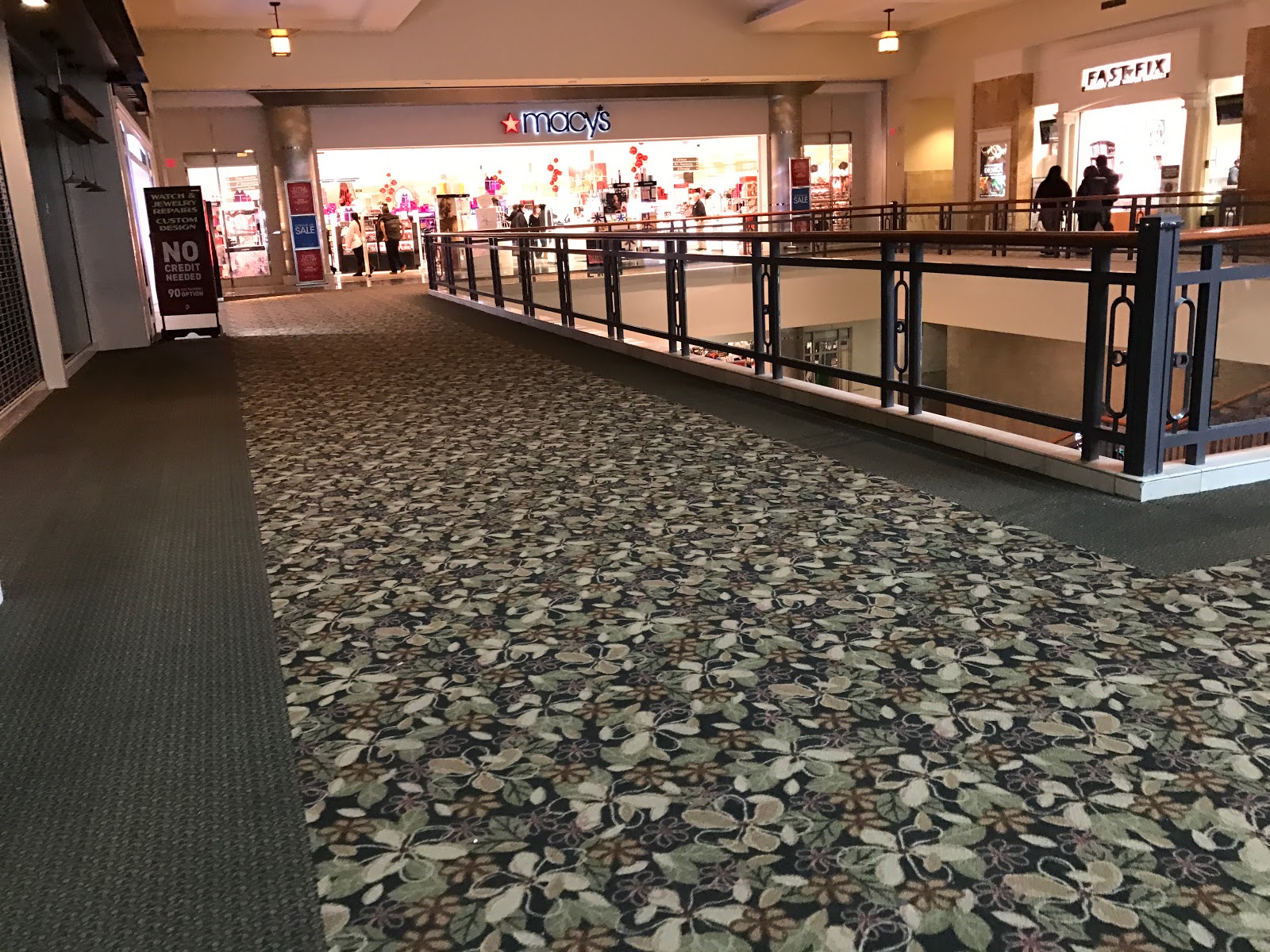
The Mall of Georgia, located in the Atlanta suburb of Buford, deserves its name. It's Georgia's largest mall, but that isn't all it can be proud of. It's a picture of what a mall can be with extensive planning after the main mall era. The mall is arguably the most unique of all of them in Atlanta, and quite appropriately, maybe even Georgia. Brought along with it was a major effect on Atlanta retail. Buford suddenly had a major retail scene and boomed following the mall's opening. Needless to say, the Mall of Georgia did some big things to Georgia, for better or worse.
 |
| Here's the directory for the crescent-shaped mall. By the way, there is another floor above the first floor map. In fact, there is a third floor too, with only a cinema. |
 |
| Here's the corridor from Dick's to the main mall. To the left of me, along with an entrance, is a bungee jumping structure. It's been there forever, though I don't know if it's been in operation since the mall opened. |
The MoG opening goes beyond the opening itself. Even in planning and construction, it was obvious Simon expected a large-scale project. And the mall goes beyond the mall itself. Looking at old aerials, Buford Drive, the road the mall is on, didn't always look the way it did. What was once a simple stop-sign I-85 exit became sprawl, with the exit becoming a cloverleaf and stoplights on both sides. What was once farmland became strip malls and big-boxes. What was once quiet roads became median-filled trafficked streets. And don't forget that most of this happened in a short time span of only a few years. Malls can definitely change a landscape, but something this scale was scarily different. Mall of Georgia's impact can even be counted for the rapid expansion of northeastern Atlanta and the fact that the suburbs pretty much go all the way to Gainesville at this point.
 |
| View of the Belk court. This acts as a divider between the center court/food court area and the eastern section of the mall. |
 |
| Belk/Lord and Taylor mall entrance. Sure, this was Belk's first Atlanta location in decades, but they didn't turn it unique. The marble entrance gives away its origin. Photoshop the Belk logo out, and add L&T's script logo the sides and you wouldn't know the difference. |
 |
| Opposite of Belk is this entrance. That's a Forever 21 on the left, one of many junior anchors. Spoiler alert : all of these entrances look the same. |
The Mall of Georgia opened up to a great start in 1999. It was one of the nation's most upscale and largest malls, and the benefits didn't stop there. The original anchors were very strong for being pre-consolidation and before the death of the various discounters. These anchors also provided a more diverse and far superior experience than other Atlanta malls. Those with money had Lord and Taylor and Nordstrom to play in. Traditional department stores had a space to exist, with Dillard's and JCPenney to shop in. Bed Bath and Beyond, Galyan's Sporting Goods, and Haverty's Furniture filled in niches for shoppers. And it wouldn't be an Atlanta mall without a Rich's, the local favorite store that entered the mall in a three-floor store. In 1999, you couldn't get much better than this. It also only seemed true that a Mall of Georgia would have top-class anchors to support it. However, only Rich's and Haverty's were actually based in Georgia. Only one would last past 2005 though, and in 2003 all was done for it.
 |
| Approaching the food court. This is where an architecturally excellent mall gets a step further. |
 |
| This is the back area of the food court. If you thought this was expansive, your thoughts won't matter soon. The kiosks cluttering the area don't help though. |
 |
| It wouldn't be a late-era mall without a carousel. |
 |
| Looking from the carousel up to the roof, featuring the large clock and the cinema sign. This makes me dizzy somehow. |
The mall would experience some small turbulence throughout its early years, but nothing to be worried about. On June 22, 2004, news came that Dick's had purchased the Plainfield, Indiana-based Galyan's concern. Shortly after, the Galyan's was converted into a Dick's operation. Galyan's was more similar to REI and Dick's had more rec sports equipment, causing the merger. But a year before, Rich's started the original consolidation to Macy's, making the mall lose an anchor in a way. This was obviously not a problem though, with Macy's taking up the spot as soon as Rich's "closed". Rich's became Rich's-Macy's, and lastly Macy's in 2005. Also around this time, Lord and Taylor left the mall and all of its other Georgia locations. Yet even this couldn't stop the mall. With far less anchor choices those days, Simon opted for the addition of a store pretty much forgotten by then for Atlantan's : Belk.
 |
| Food courts don't get much better than this. This is supposed to resemble a former Atlanta train station. Why do all train stations seem to have the NBC peacock look? |
 |
| This was taken to show the levels of the mall, from first to second to third. |
 |
| Here's one side of the food court area. Note the gingerbread house-designed roof. I find it a little weird with the rest of the mall. |
Belk brought much more than the Mall of Georgia store with it. Today, Atlanta is the biggest market for the store, with the 20 metro locations (soon to be 19, with the closure of the Phipps Plaza store) and a local liking. The markets include even Charlotte, which is where Belk is headquartered, and Dallas, Belk's newest market. It helped that Belk entered the market after Rich's left, clearing a strong competitor. In fact, Belk's entrance helped a lot for Georgia as a whole. It gave way to more urban Belks, when the store only had a knowledge of rural areas. If Mall of Georgia did hurt other malls, it at least did something for the state.
 |
| Now we head into the western section of the mall. This small area is probably the most toned-down section of the mall. I would go as far to saying it looks a bit plain and like every other 90's mall. |
 |
| 90's corridor, meet 90's Penney's look. 90's Penney's look, meet 90's corridor. |
 |
| Here's the JCPenney court. It at least looks a little different. Good news, things only pick up from here. |
The last anchor switch came pretty recently. Nordstrom left their anchor spot in 2015, giving way for Von Maur's third Atlanta store. I'm a little surprised with the closure of Nordstrom. The Buford area gained lots of new money thanks to the mall and Lake Lanier is nearby. Buford is far from poor, or even middle-class. It's also one of the hottest and cheapest real estate markets in the US. Buford could have easily handled a Nordstrom store, in my opinion. The reason behind the closure remains a mystery to me, and possibly Buford residents alike.
 |
| Going farther down the mall. In the background is the start of the Plains section and the Macy's court. |
 |
| Macy's, once Rich's, doesn't sport anything special. This is ironic, because Rich's was special, but Macy's really isn't. It's not a great sign when pretty much every mall had a Macy's at some point. |
 |
| In Macy's court is this decent fountain. This isn't the only fountain in the mall, but one of five. A fountain is also located in The Village, a lifestyle section outside the food court. I didn't photograph that as it was raining and cold. |
The Mall of Georgia is pretty much on top of the world now. The mall is in its prime, and has never looked better. This felt obvious to me as I visited on a Sunday afternoon and struggled to take pictures. The mall was packed by the thousands. Every food place had a solid line and the food court was filled with people. This isn't a small, dinky food court, mind you. This is a cavernous food court with oodles of seating. The situation was so bad that I saw people eating on the benches on the second floor. Included in the fun were the anchors, all decked out for Christmas and filled with people. It was a splendid scene to see. Sure, lots of malls are dying nowadays, but not every one is. Mall of Georgia has the look, vibe, and crowd to show it can be a contender decades down the road. Days like this are helping its cause.
 |
| Here we enter the Coastal section, which looks like a plantation in mall form. This section includes Dillard's and Shoe Dept., a major junior anchor. |
 |
| Dillard's entrance is easily complemented by the surrounding architecture. Dillard's could have put an all-white entrance and it still would have looked good. |
 |
| Dillard's from close-up. |
Mall of Georgia is a unique case for a mall. Despite its size and opulence, you could say there's only one thing to be worried about. JCPenney is the only anchor I'm worried about. I'm interested in what the plans for the store are given that the company isn't really doing so hot as of late. Does Nordstrom reenter the picture? For replacements, all I can think of are upscale options. This puts an interesting scene in the movie, given that Buford has money. Wealthy folks spend their weekends often at their Lanier lakehouses, giving the mall a regular boost of rich consumers. The Buford area is also home to a few notable people, including Atlanta Falcons receiver Julio Jones. A man getting paid multi-million dollars isn't moving to the bad side of town.
 |
| Dillard's from the second floor. Should I be worried that a mall is ready for Christmas over a month before the actual holiday? |
 |
| Near Dillard's is this unremarkable entrance. |
 |
| Macy's from the second floor. |
 |
| Entrance wing across from Macy's. Haverty's entrance is down there. |
Anyways, future aside, the Mall of Georgia carries some architectural clout. The mall is divided into multiple sections, representing the terrain of Georgia. One section shows the mountains, the piedmont, the coast, and the plains. Also included are two arcades near the food court. Numerous fountains populate the mall throughout, with the grandest one being in the Village. This fountain is the largest and opens up, meaning children can play in it during the summer heat. The other fountains are still special though. Each section has its own fountain, except the food court. These fountains fit in with the theme of the section they are located in. In an era where it seems fountains are being neglected, seeing them aplenty in a mall is refreshing (no pun intended).
 |
| Here's the second floor view of the Plains section. |
 |
| I didn't take this photo to show Finish Line but instead the interesting accent feature. Throughout the mall, signs like this list off municipalities, towns, and counties in Georgia. This would probably only work in, well, the Mall of GEORGIA. |
 |
| The end of the Plains section. Each section greets shoppers with a large sign sporting the main theme. |
 |
| JCPenney entrance wing. All the entrances look the same for the most part. |
 |
| JCPenney from the second floor. |
If you like it or not, the Mall of Georgia changed the norm of shopping in Atlanta. If you are unhappy with this, you must realize that MoG isn't only to blame. Not far south is the Mills-developed Sugarloaf Mills. These malls opened back to back with a common target. Gwinnett Place Mall reigned supreme for 16 years and was beginning to age. Atlanta had boomed through the 90's and carried a strong economy. And so the two shopping pillars were constructed. Gwinnett Place was pretty much doomed from then on. It currently operates in dead mall status with Macy's, Sears, and two nontraditional anchors (more info elsewhere on this blog). Sure, a perfectly good was ruined, but does it matter when it's replaced by a perfectly good, even better, mall?
 |
| Theatre. |
 |
| To put in perspective on the sheer size of the mall, here's a photo from the third floor to the first. It's trippy. |
 |
| Technically, this is the main entrance. This is the opposite of the food court on the second floor. |
 |
| Back towards Von Maur is this empty anchor pad. If Simon ever felt the need to expand, this is probably where it would go. This was possibly for Parisian, but that's out of the question with Belk here and the fact that Parisian died out 11 years ago. |
It's safe to say that you shouldn't be in a rush to visit the Mall of Georgia. So often we love dead malls, but sometimes you need to step back and look at the bigger picture. Live malls aren't always washed down and tasteless. MoG is an example of this. It's one of the best in the US, yet by no means is it boring. The architecture is excellent and the enjoyment is endless. I love a dead mall too, but do they check these boxes?
 |
| Now for the decadent mountain wing. The Christmas décor takes this to a new level. |
 |
| Von Maur from up closer. |
 |
| Barnes and Noble. |
 |
| Dick's look as it normally would. |
 |
| Von Maur's newest stores look nice as always. |
 |
| The only other decent outdoor photo I have is this one of Macy's. |